Skaftafell Glacier Hike: Which Ice You Actually Walk
Book a glacier hike in Skaftafell and the ice under your crampons will almost certainly be Falljökull. The name on the listing is the car park, not the glacier. Compare the three guided levels on this ice or read on for what separates them.
Quick answer
A Skaftafell glacier hike leaves from the tour base beside the national park and walks Falljökull, an outlet glacier of Vatnajökull. Three levels run from the same building: $105 for 3 hours, $162 for 5 hours, and $251 with roped ice climbing. Crampons, helmet, harness and ice axe come with every ticket, and no operator lets you onto the ice alone.
Key takeaways
- The ice you walk is Falljökull. Skaftafellsjökull, the glacier the park trail points at, is a viewpoint rather than a hiking surface
- Cheapest way on: the easy hike at $105 for 3 hours, about 90 minutes of it on the glacier, minimum age 8
- Most ice for the money: the advanced hike at $162 for 5 hours with around 3 hours walking on the glacier, groups of 10
- Ice climbing: $251, groups of 6, no previous climbing experience needed
- Free alternative if you would rather not book: the park's S1 trail, a 4.1 km loop to a viewpoint over Skaftafellsjökull
- All three tours cancel free up to 24 hours before departure. Parking at the visitor centre costs 1,040 ISK on top
Which Glacier a Skaftafell Glacier Hike Walks
Three Tongues, One Car Park
Skaftafell is a place, not a glacier. Within fifteen kilometres of the visitor centre three outlet glaciers come down off the Öræfajökull massif, and they are not interchangeable.
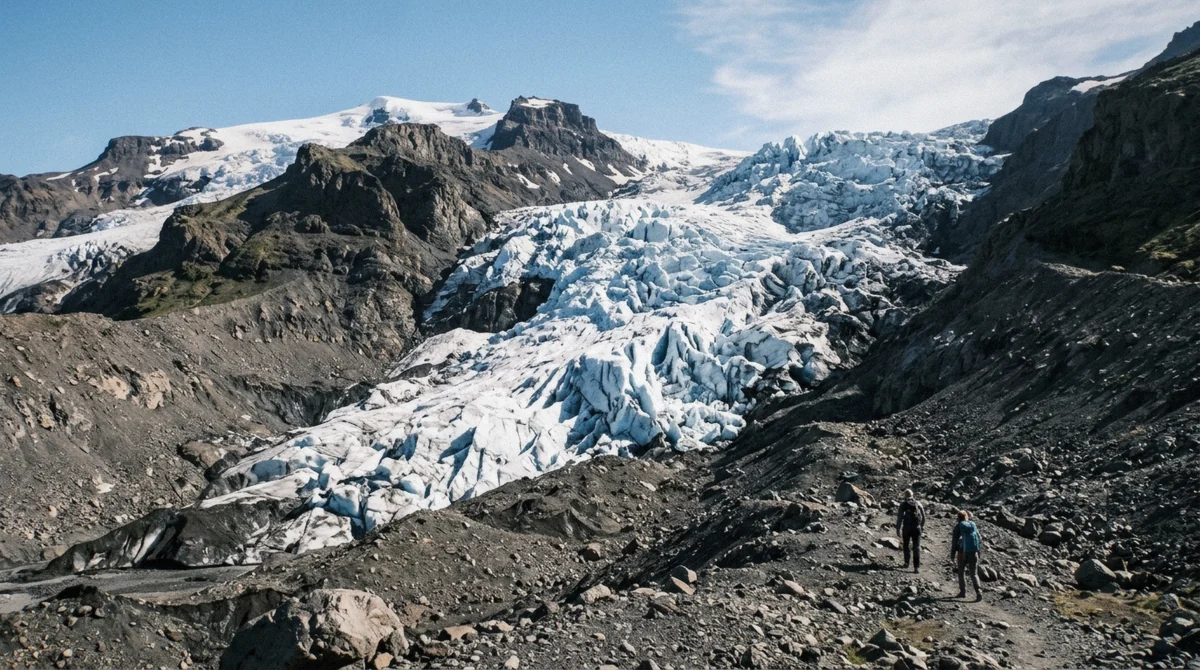
Falljökull is the one guided hikes walk. It falls steeply enough to break into an icefall, which gives it the crevasses and moulins that make the walk worth the money. Skaftafellsjökull is the flatter tongue at the end of the park's own trail, and Svínafellsjökull, ten minutes west, is closed.
Operators sell all of this as a Skaftafell glacier hike because that is what people search for, and because the meeting point sits by the park entrance. Nobody is misleading you. It helps to know which ice you booked when you are reading two listings that describe the same walk in different words.
Why Not Skaftafellsjökull
Skaftafellsjökull is the glacier at the end of the S1 trail, a 4.1 km loop that takes an hour to an hour and a half and finishes at a viewpoint over the ice. Walk it for free, in trainers, without booking anything.
What it does not offer is a surface worth a guided day. The snout is flat, grey with moraine and cut by a meltwater lagoon that has grown across the approach. Standing at the end of that trail, you look at a glacier. Ninety minutes up the road on Falljökull, you walk between blue walls.
- S1 glacier trail: 4.1 km loop, 1 to 1.5 hours, easy, free
- S2 Svartifoss trail: 5.8 km, about 2 hours, basalt columns behind the falls
- Both start at the Skaftafellsstofa visitor centre car park
- Parking 1,040 ISK, paid at the kiosk or online, valid for the day
The Glacier You Cannot Book
Svínafellsjökull used to carry glacier hikes and film crews. It carries neither now. Surveys found a fracture on the Svínafellsheiði slope above it in 2014, then a second one in 2018, and remote sensing showed the block between the fractures and the glacier margin creeping 2 to 4 cm a year.
The rough estimate puts 60 million cubic metres of mountain in motion. Iceland's Civil Protection agency advises against travel on the glacier, and names guided tours in that advice. Operators moved their trips to Falljökull, which is part of why the Falljökull tours run as full as they do.
Guided Skaftafell Glacier Hikes on Falljökull
Same base, same guides, same gear. The difference is how long you stay on the ice and whether a rope comes out.
 from $105Most Booked — 4.6★, 1,618 Reviews
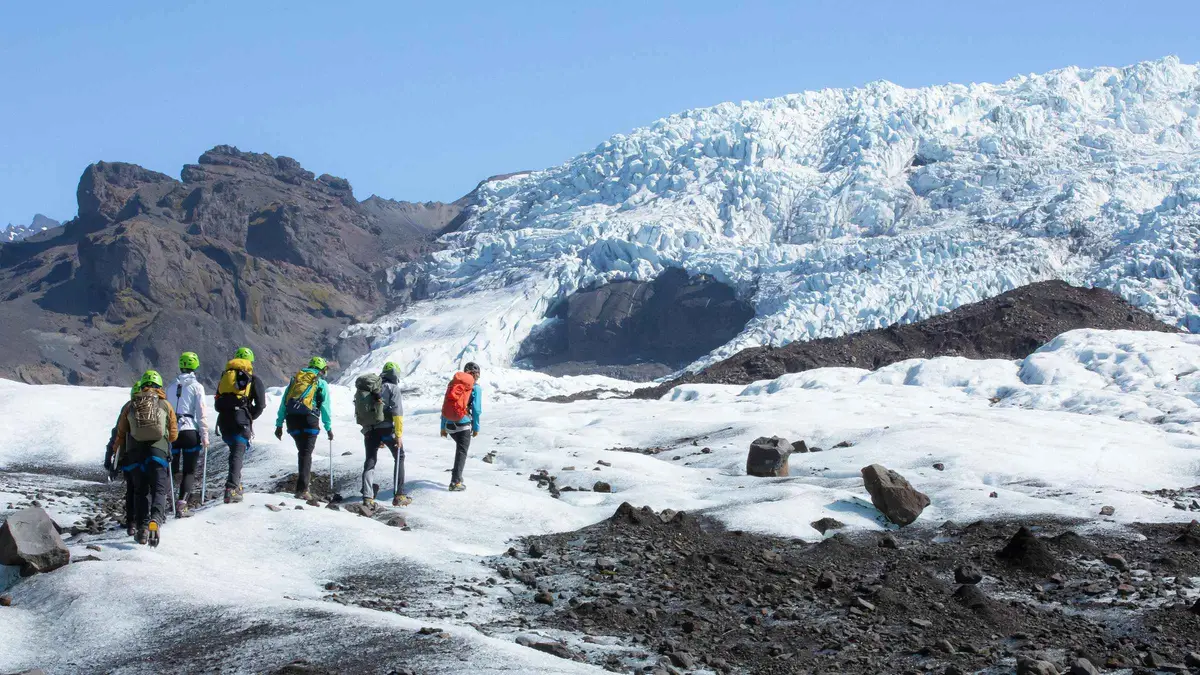
 Falljökull Easy Glacier Hike from Skaftafell
The entry-level walk on Falljökull, and the one most people book. Three hours door to door, of which roughly 90 minutes are spent on the ice itself, with…
- Roughly 90 minutes walking on the ice, 3 hours in total
- Groups capped at 14 with a certified Icelandic glacier guide
- Crampons, helmet, harness and ice axe issued at the meeting point
- Minimum age 8 — the only Falljökull tour open to younger children
 from $162Top Rated — 4.8★, 1,149 Reviews
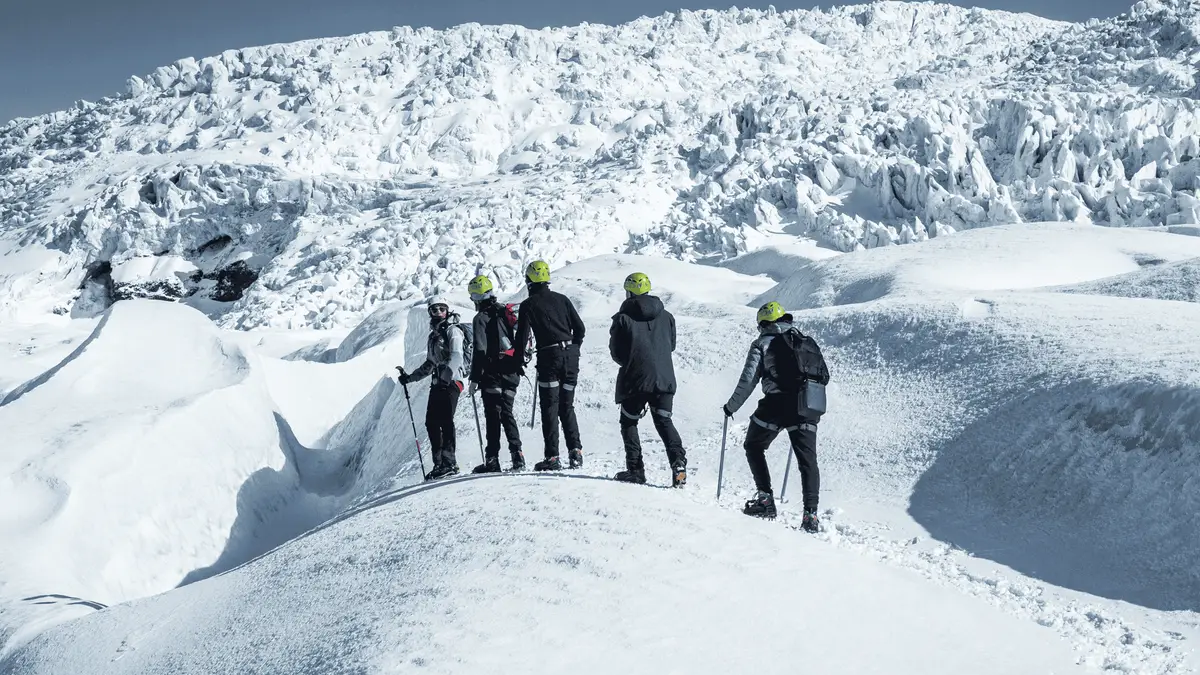
 Falljökull Advanced Glacier Hike
Five hours from the Skaftafell meeting point, with about three of them on Falljökull itself, climbing far enough up the icefall for the crevasse field and the views…
- About 3 hours on the ice — the longest walking time of the three tours
- Climbs high enough for crevasses, moulins and the upper icefall
- Small group, limited to 10 participants
- Sweeping views back over Skaftafell National Park from the upper glacier
 from $251Smallest Group — Max 6 People
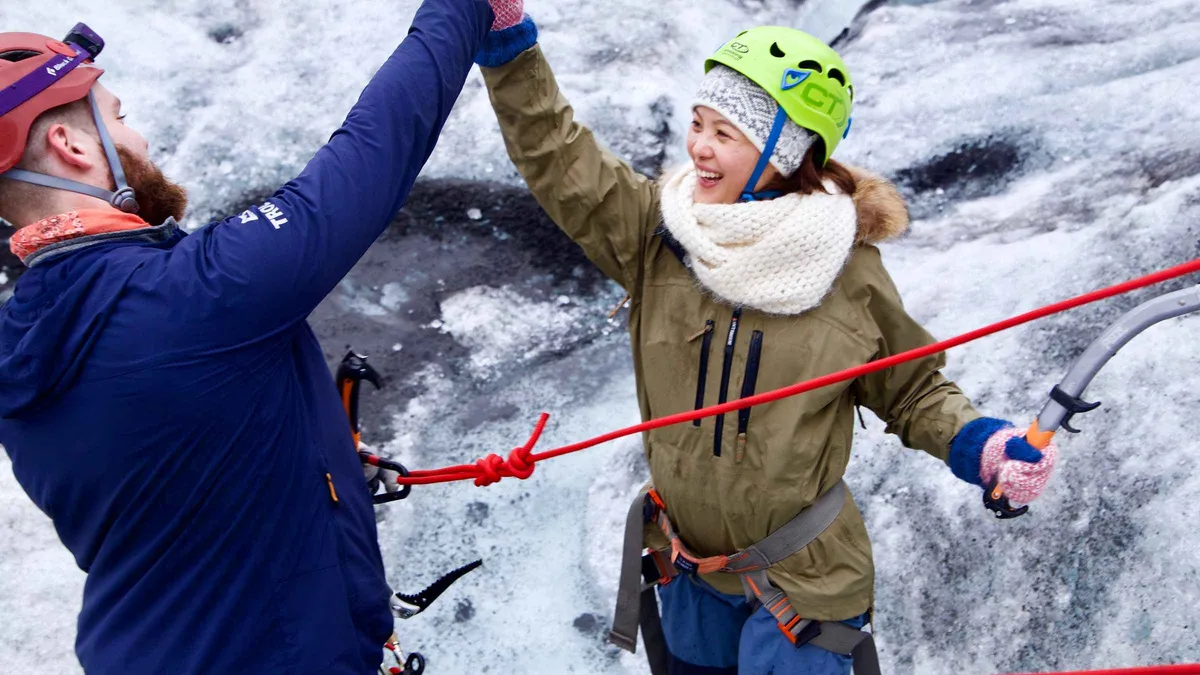
 Falljökull Ice Climb and Glacier Hike
A glacier hike with a roped ice-climbing session built into it: the guide sets an ice screw and safety line on a wall or crevasse and each person…
- Roped climb on an ice wall or into a crevasse, ice screw set by the guide
- No climbing experience needed — technique is taught on the spot
- Smallest groups of the three tours, capped at 6 participants
- Climbing boots, ropes, harness, crampons, helmet and ice axe provided
The Three Levels Compared
Read the on-ice column first. Total tour length includes gear fitting, the shuttle and the walk in, which is where the easy hike spends most of its three hours.
| Tour | Price | Total | Book | On the ice | Group | Min age |
|---|---|---|---|---|---|---|
| Ice climb and hike | $251 | 4 hours | Check | About 3 hours | 6 people | 12 |
| Advanced hike | $162 | 5 hours | Check | About 3 hours | 10 people | 12 |
| Easy group hike | $105 | 3 hours | Check | About 90 minutes | 14 people | 8 |
Prices per person in USD, checked July 2026. Food and hotel pickup are not included on any of the three. Boots and waterproofs rent at the meeting point.
How Difficult Is a Skaftafell Glacier Hike
What the Walking Is Actually Like
Crampons change how you walk more than they change how hard it is. You plant your foot flat, keep your feet further apart than usual, and stop crossing your ankles. Guides teach it at the ice edge and it takes about ten minutes to stop thinking about it.
The easy hike stays on gentle ground and gives about 90 minutes on the glacier. Reviewers say plainly that more of those three hours goes on the approach than on the ice, which is the honest trade for the price and the age-8 minimum.
The advanced hike climbs. Three hours of walking with gradient, on a surface that drains your legs faster than a footpath, and reviewers who describe themselves as active still finish it winded. One of them hiked it 27 weeks pregnant and said the same thing: doable, tiring, worth it.
Fitness, Age and Who Turns Back
No tour here asks for climbing experience. What they ask for is the ability to keep walking for the advertised time without holding up a group of ten.
Minimum age is 8 on the easy hike and 12 on the advanced hike and the ice climb. Older walkers do fine: guides pace to the slowest person, and reviews from this glacier repeatedly mention a guide taking time with someone in their sixties rather than pushing on.
- Comfortable on a two-hour country walk: the easy hike works
- Regular hill walking: the advanced hike is the better value
- Knee trouble on descents: say so at the meeting point, the guides adjust the route
- Never used an axe: that is the normal starting point for the ice climb
Can You Hike the Glacier Without a Guide
The Short Answer
No, and this is not an upsell. Crevasses open under thin snow bridges, the surface shifts through the season, and a certified glacier guide carries the rope, the screws and the knowledge of which line held up this week.
Rescue in Öræfi means calling teams who have to travel, and the ground you fall into is cold and vertical. Operators will not take you onto the ice without gear, and no park rule pretends the ice is a marked trail.
What You Can Do for Free
Walk the S1 trail to the Skaftafellsjökull viewpoint, 4.1 km round trip and an hour and a half at a slow pace. It shows you the snout, the moraine ridges and the lagoon that formed as the ice pulled back, all without a booking.
Pair it with S2 to Svartifoss, 5.8 km and around two hours, and you have a full free day in the park. Neither trail needs crampons, and both start at the same visitor centre car park where the tour buses load.
What Reviewers Say After the Walk
The Guides Score Higher Than the Tours
Across the three tours from this base, guide ratings sit above the overall score every time: 4.9 out of 5 for the guide on the advanced hike against 4.8 overall, and 4.8 for the guide on the easy hike against 4.6. Value for money is the lower number in both cases, 4.6 and 4.3.
That gap tells you what to expect. People come off this glacier praising the person who took them, and the grumbling, where there is any, is about how the ticket was described rather than how the day was run. Names repeat in the reviews often enough that regulars ask for specific guides.
The Two Complaints Worth Reading
On the easy hike, the recurring line is that more of the three hours goes on the approach than on the ice. That is accurate. Ninety minutes on the glacier out of a three-hour slot is what the operator advertises, and the shuttle plus the walk in eats the rest.
On the advanced hike, some reviewers say the difficulty label and the group mix do not always match. A group of ten can hold people with very different paces, and the guide sets the speed for the slowest. If you booked the advanced hike for a workout, that is worth knowing before you stand at the meeting point.
Neither complaint is a reason to skip the tour. Both are reasons to pick the right one.
What Keeps Coming Up as a Highlight
Three things recur in the reviews from this glacier. The moment the group first walks between two ice walls higher up. The guides explaining how far the ice has pulled back within their own working lives, with the moss line on the valley wall as the proof. And the coffee and Icelandic chocolate at the end, which shows up in reviews far more often than a hot drink has any right to.
More than a few people also write that they came for a photograph and left unsettled by how fast the glacier is going. That is the honest emotional shape of a day here.
Recent Reviews from This Glacier
This tour was amazing. I could never imagine going that far up on a glacier, and every moment was an unforgettable view. We took the 5 hour tour. It was tiring but definitely worth it.
We went in early May and saw moulins, moraines and crevasses. Our guide was very knowledgeable, and we got to drink glacier water by picking at the ground and creating a mini stream.
The activity was great and the guide was awesome. It is not very challenging and easily doable for anyone wanting to do it.
We were with a small group, which meant we could move quite fast and get up quite high on the glacier. The guide was a lot of fun and very knowledgeable.
Practical Details for the Day
Meeting Point, Gear and Timings
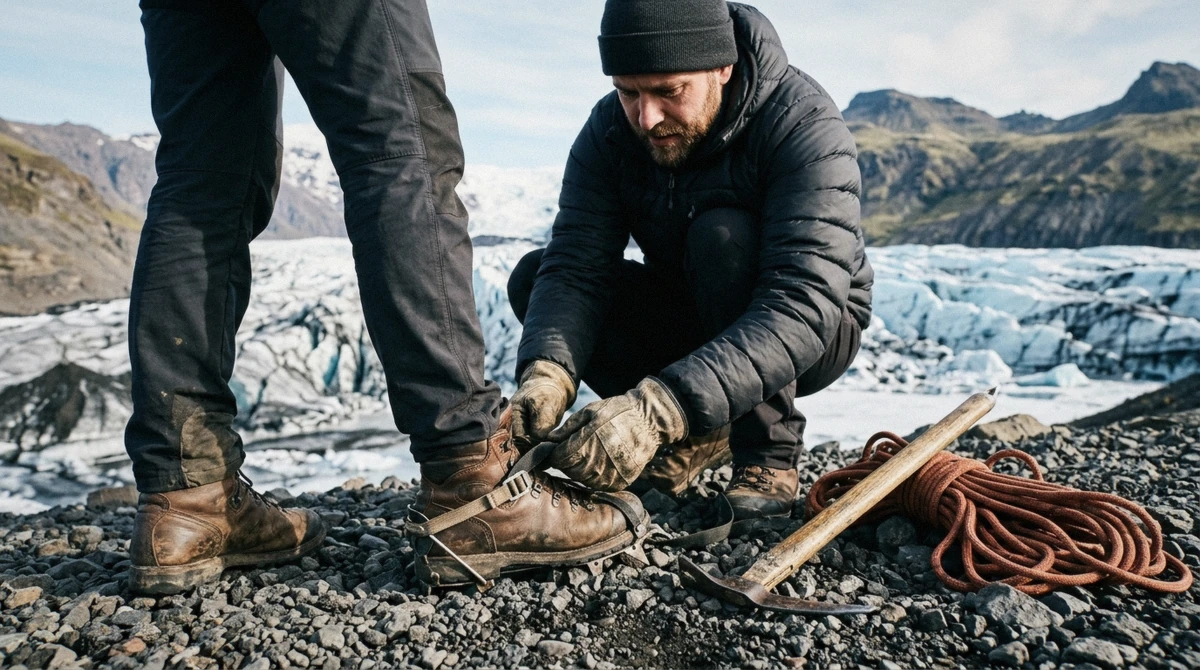
You meet at the tour base on Route 1 at Hof, 1 km west of Hofgarður, 20 minutes before departure, where the guide fits crampons, helmet, harness and an ice axe. Climbing boots and ropes come out for the ice climb.
A 10-minute shuttle takes the group toward the glacier car park, then a 15 to 20 minute walk gets you to the ice. That approach lengthens most years as the snout retreats up the valley.
Hiking boots and waterproofs are not included and rent on site. Food and hotel pickup are not included either, so pack water and something to eat.
| What | Detail |
|---|---|
| Meet | 20 minutes before departure at the Tröll base, Route 1 at Hof |
| Included | Certified glacier guide, crampons, helmet, harness, ice axe |
| Not included | Food, hotel pickup, hiking boots, waterproofs |
| Rent on site | Boots, waterproof jacket and trousers |
| Cancellation | Free up to 24 hours before departure |
| Park parking | 1,040 ISK at the visitor centre, separate from the tour |
Getting to Skaftafell
Skaftafell sits on Route 1, 335 km east of Reykjavík, which is four and a half hours of driving before stops. Vík is 147 km west and Jökulsárlón 57 km east, about 50 minutes.
Skaftafellsstofa, the park visitor centre, opens at 9am for most of the year and 10am from December to February, closing between 5pm and 7pm depending on season. If you are driving out from Vík on the morning of the tour, book the later departure and give yourself the extra hour.
What to Wear
Waterproof shell top and bottom, warm mid-layer, hat and gloves, and stiff hiking boots that cover the ankle. Crampons will not clamp to soft trainers, which is the single most common reason someone ends up renting boots at the base.
Leave cotton in the car. Standing still on ice in a damp t-shirt while the group photographs a moulin is how people get cold on a summer tour.
Skaftafell Glacier Hike in Summer and Winter
June to August
Long light, warm rock, and a glacier surface stripped bare of snow. The crevasse field reads at its clearest in August, when nothing bridges the smaller splits and you can see how the ice bends over the slope beneath it.
The cost is the approach. Meltwater runs across the moraine, the walk in from the car park takes its full 15 to 20 minutes, and the ice underfoot is wet rather than crisp. Book a morning departure: afternoon slots sit in the warmest, softest part of the day.
September to November
The quietest good window here. Daylight still runs nine to thirteen hours, the summer coaches have gone, and the first freezes firm up the surface without covering it.
Operators start scouting winter features in this period. Nothing is guaranteed, but late-season groups occasionally get taken past a tunnel that will become a proper cave by December.
December to March
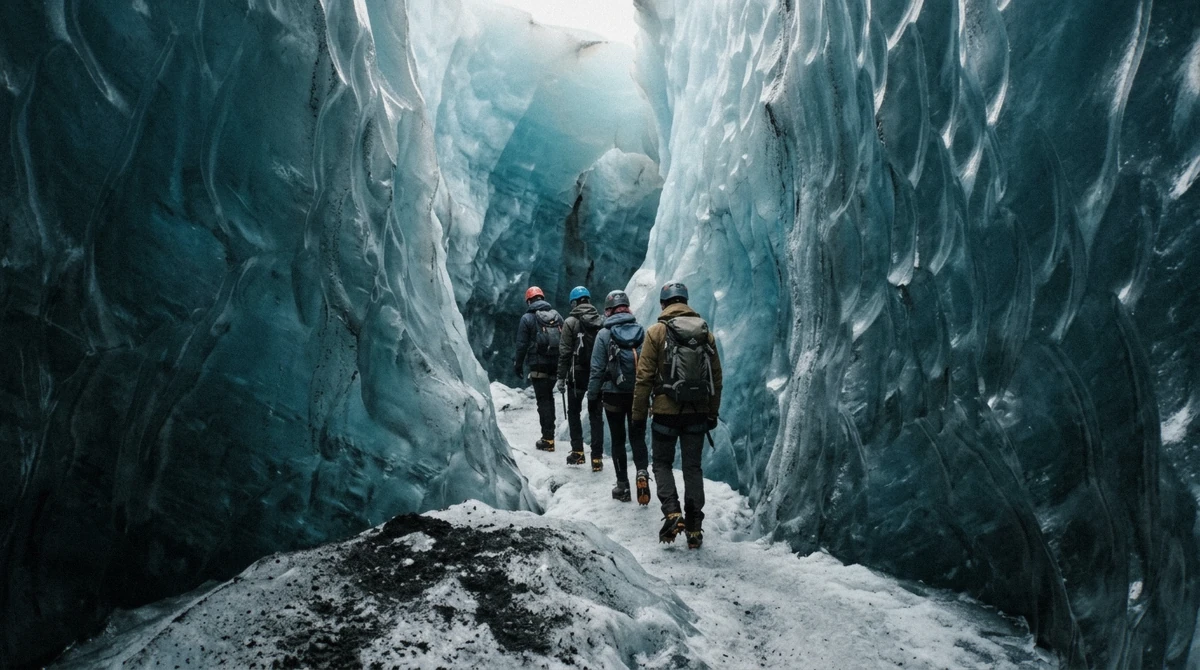
This is the blue ice season and the ice cave window, and it is also five hours of usable light in the last weeks of December. Departures start later and finish earlier, and the guides watch the wind more than the temperature.
Snow bridges the smaller crevasses in this period, which is exactly why nobody walks out here without a guide in winter. Roads matter too: Route 1 closes in storms, and the drive from Reykjavík that takes four and a half hours in July can take much longer or not happen at all in January.
- Check road.is the morning you drive, not the night before
- Book the first departure in winter and keep the afternoon clear
- A cave tour names the cave in the title; a hike never promises one
- Free cancellation runs to 24 hours out, and the operator refunds in full if they cancel
Booking a Skaftafell Glacier Hike
How Far Ahead to Book
Through July and August the morning departures on the advanced hike go first, often a week or more out, because they carry ten people and the day is long enough to still get to Jökulsárlón afterwards. The ice climb runs with six and sells out on the strength of that number alone.
Outside high summer you can usually book two or three days ahead. Free cancellation up to 24 hours before departure means an early booking costs you nothing if the forecast turns, so there is no reason to wait for certainty that Icelandic weather never provides.
Fitting the Hike Into a South Coast Drive
Most people reach Skaftafell as part of the run east from Reykjavík toward Jökulsárlón, and the glacier hike is what turns that drive into a stop rather than a photograph through a windscreen.
A workable shape: sleep near Vík or Kirkjubæjarklaustur, drive to Skaftafell for a morning departure, walk the Svartifoss trail after lunch, then push the 57 km east to the lagoon for late afternoon light on the icebergs. That is a full day and it needs the earlier tour slot to hold together.
| From | To Skaftafell | Drive |
|---|---|---|
| Reykjavík | 335 km | About 4.5 hours on Route 1 |
| Vík | 147 km | About 2 hours |
| Kirkjubæjarklaustur | 70 km | About 1 hour |
| Jökulsárlón | 57 km | About 50 minutes |
| Höfn | 126 km | About 1.5 hours |
What the Ticket Does Not Cover
Food and hotel pickup are not included on any of the three tours. Hiking boots and waterproofs rent at the base if you need them, and the 1,040 ISK parking fee at the visitor centre is separate from anything the operator charges.
Budget for fuel as well. The stretch between Vík and Höfn has few stations, and prices at the ones out here run above Reykjavík.
What You Walk Past on the Way Up
The Moraine and the Moss Line
The walk in crosses ground the glacier left behind. Loose grey rock, braided meltwater channels that move between visits, and ridges of debris the ice pushed up when it still reached this far.
Look at the valley wall as you go. A clear line runs along it where moss and low growth stop, and everything below that line is ground the ice covered within living memory. Guides use it as a pointer, because it makes the retreat legible in a way that a number on a page does not.
The First Crevasse Field
Crampons go on at the ice edge, and the first twenty minutes are flat enough to get your feet working. Then the surface starts to bend and the splits appear.
Most of them are narrow enough to step over with the guide standing beside them. A few are wide, and you walk around. The blue inside deepens with depth, because the ice down there has had the air pressed out of it over centuries and only the blue end of the light comes back out.
Moulins, Ash Bands and Glacier Mice
Higher up you meet the features people photograph. A moulin is a shaft melted vertically by draining meltwater, round-walled and loud in summer when the water is still running through it. Guides keep groups well back from the lip.
Dark bands lie in the white where volcanic ash fell on the ice and got buried by later snow. Öræfajökull put down two of the big ones, in 1362 and again in 1727. On the flatter sections you will also find glacier mice: loose balls of moss that sit on the surface, roll slowly with wind and melt, and stay alive because the ball keeps its own moisture.
The View Back Over the Park
The advanced hike gains enough height for the view that makes the extra two hours worth booking. Skaftafell National Park opens out below, the black outwash plain runs to the sea, and Hvannadalshnúkur sits on the caldera rim at 2,110 m behind you.
On the easy hike you turn around before this. That is the clearest single difference between the two tickets, and it is worth weighing against the $57 that separates them.
The Gear and What Each Piece Does
Crampons, Axe, Harness, Helmet
Every tour hands out the same four items at the base. Crampons are steel frames with downward and forward points that strap to a stiff boot and bite the ice; they are the reason the walk works at all, and the reason soft trainers get someone sent to the rental rack.
The ice axe doubles as a walking stick on gentle ground and a brake if you slip. The harness matters most on the ice climb, where the guide clips you to a rope run through an ice screw. The helmet covers falling ice near the walls and, more often, your own head hitting the ice if you go down.
| Item | What it does | Who needs it |
|---|---|---|
| Crampons | Steel points that grip the ice | Everyone, on every tour |
| Ice axe | Balance on the walk, brake on a slip | Everyone |
| Harness | Ties you to the rope | Required on the ice climb |
| Helmet | Head protection near walls and on falls | Everyone |
| Stiff boots | The platform crampons clamp to | Bring or rent at the base |
Rented Boots Are Fine
The rental boots at the base are worn but stiff, which is the property that matters. Wear thick socks and take the time to lace them properly before you leave, because adjusting a boot with crampons on at the ice edge is a slow job with cold fingers.
If you own boots and are unsure, press the sole. If it flexes easily in the middle, the crampon will lever off it. That test takes two seconds and saves the argument at the meeting point.
Skaftafell Glacier Hike Map
Meeting point, the glacier you walk, the glacier you look at, and the one that is closed.
Skaftafell or Sólheimajökull
These two glaciers turn up in the same searches and sit 200 km apart. Sólheimajökull is the day trip you do from Reykjavík. Skaftafell is the one you drive to and stay near.
| Skaftafell (Falljökull) | Sólheimajökull | Book | |
|---|---|---|---|
| Drive from Reykjavík | 335 km, about 4.5 hours | 158 km, about 2.5 hours | |
| The ice | Steep icefall, crevasses, moulins | Flatter tongue, ash-streaked surface | |
| Typical price | $105 to $251 | Usually cheaper, more operators | |
| Crowds | Small groups, capped at 6 to 14 | High volume, buses from the capital | |
| Best for | Anyone already driving the south coast east | A day trip out of Reykjavík and back |
Both run year-round. Natural ice caves are a November to March add-on at either, and no operator can promise one on a hiking ticket.
Skaftafell Glacier Hike Questions
Which glacier is the Skaftafell glacier hike on?
Falljökull, an outlet glacier of Vatnajökull that drops from Öræfajökull toward the Skaftafell valley. Skaftafellsjökull is the tongue at the end of the park's S1 trail and is a viewpoint walk, not a hiking surface. Compare the guided options on the three levels on Falljökull.
Can you do a Skaftafell glacier hike without a guide?
No. Crevasses open under snow and the ice moves through the season, so nobody should step onto it without a certified glacier guide and crampons. The free alternative is the S1 trail, a 4.1 km loop to the Skaftafellsjökull viewpoint.
How much does it cost?
The easy group hike is $105 for 3 hours, the advanced hike is $162 for 5 hours and the ice climb is $251 for 4 hours. Gear is included, food and hotel pickup are not, and parking at the visitor centre costs 1,040 ISK on top. Tour by tour: easy hike, advanced hike, ice climb.
How difficult is it?
The easy hike suits anyone comfortable on a two-hour walk, with about 90 minutes on the ice. The advanced hike asks for three hours on crampons with gradient. Crampon technique takes ten minutes to learn and no tour needs previous experience.
What is the minimum age?
Eight on the easy hike, twelve on the advanced hike and the ice climb. Families with younger children usually walk the S1 trail instead and book the easy hike from the Skaftafell base for the older ones.
Can you hike a glacier in Skaftafell in summer?
Yes, tours run year-round. Summer gives up to 21 hours of daylight and a bare crevassed surface, at the cost of a longer 15 to 20 minute walk in from the car park. Winter gives blue ice, short light and the November to March ice cave window.
Can you combine the hike with an ice cave?
Only between November and March, and only on a tour that names a cave in the title. Small caves open on Falljökull in winter and melt out by spring, so a standard hike never guarantees one.
Skaftafell or Sólheimajökull?
Sólheimajökull is 158 km from Reykjavík and works as a day trip; Skaftafell is 335 km east and suits anyone already driving toward Jökulsárlón, 57 km further on. The ice at Skaftafell is steeper and more broken.
Where do the tours meet?
At the operator's base beside the national park on Route 1, 20 minutes before departure, where parking is free. That is a different car park from the visitor centre, where the 1,040 ISK fee applies and the S1 and S2 trails start.
Do you need hiking boots for a Skaftafell glacier hike?
Yes, stiff-soled boots that cover the ankle. Crampons lever off soft trainers and running shoes. The operator rents boots at the base, along with waterproof jackets and trousers, if you did not bring your own.
How long is the walk from the car park to the ice?
A 10-minute shuttle from the meeting point, then a walk of 15 to 20 minutes over moraine to the ice edge. That approach has grown as the snout retreated, and it is why the easy hike spends more of its three hours off the glacier than on it.
What happens if the tour is cancelled for weather?
The operator refunds in full when they cancel, which they do for high wind, heavy rain or lightning near the ridge. Your own free cancellation runs separately, up to 24 hours before departure. Build a spare morning into the trip if the glacier is the reason you drove east.